

THE ARCHITECTURE OF CONNECTION
How Frankfurt and the Rheingau are redefining luxury hospitality through sensory design, cinematic history, and civic empathy.
By Lan TRAN THU
There is a distinct moment when a journey transitions from a standard itinerary into an emotional awakening. For me, that shift occurred before I had even checked into my first room.
I had arrived in Germany for a curated press trip hosted by the Frankfurt Convention Bureau, centered on a theme gaining global momentum: “Design meets Wine.” Expecting a masterclass in regional aesthetics, I was instead handed a welcome letter detailing a gesture that shattered the corporate mold. In lieu of a traditional welcome gift, hosts Jutta Heinrich, Sarah Himmelreich, and Jessica Mayer had made a €50 donation in my name to fund swimming lessons for underprivileged children at the "Alte Villa" daycare centre, run by Caritasverband Frankfurt.
For someone who grew up in the Mekong Delta, where water is not a recreational choice but a baseline for survival, this struck an intensely personal chord. It was a profound reminder of a singular truth: the ultimate purpose of design—whether of an experience, a building, or a regional strategy—is to support human life and build bridges of empathy.
As Frankfurt RheinMain steps onto the global stage as World Design Capital 2026 under the banner "Design for Democracy – Atmospheres for a better life," this spirit of intentionality is precisely what is reshaping the region's luxury and hospitality landscape.
The Urban Living Room
Hospitality as Experience Architecture
In the heart of Frankfurt, modern hospitality has transcended the traditional boundaries of service. It has become a form of experience architecture, where spaces are deliberately choreographed to dictate how we move, feel, and interact.
Take The Florentin, where hospitality is elevated to an art form, treating the guest experience as a living canvas. Here, the boundaries between public and private spaces blur, creating an environment that feels less like a hotel and more like a curated cultural salon.
This intentionality carries through the city's most distinct neighbourhood anchors:
- Kimpton Main Frankfurt: A masterclass in texture and curation, where provocative contemporary art meets fluid architectural design, turning communal spaces into hubs of spontaneous human connection.
- Kennedy 89: A property that leans beautifully into 1960s design nostalgia, using mid-century geometry and sophisticated materials to create a cinematic, comforting warmth that immediately softens the traveler’s pace.
In these spaces, design is not used as a decorative afterthought; it is used as a tool to cultivate specific emotional atmospheres.
Vertigo and Verandahs
The High-Gloss and the Hidden
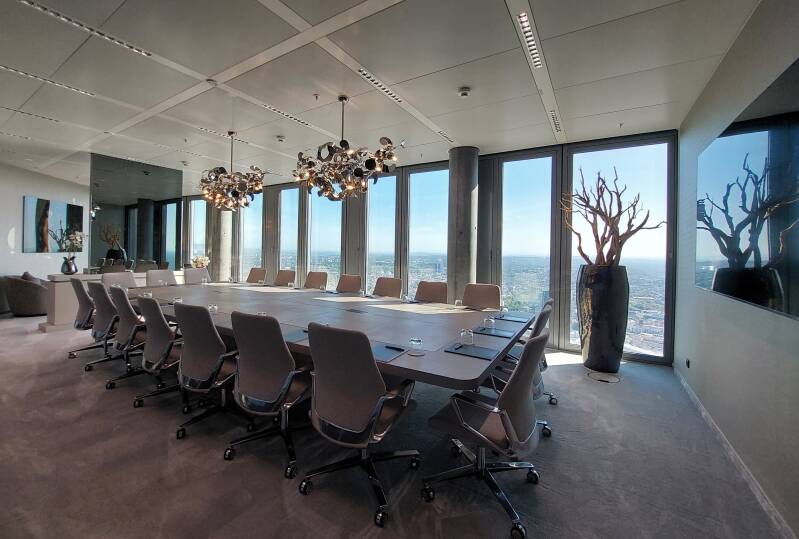
To understand Frankfurt’s forward-looking design philosophy, one must look both up and out. At FOUR Frankfurt, a visionary multi-tower development in the financial district, I stood in Europe’s highest business center, designed by Eric Kuster Metropolitan Luxury. From this vantage point, looking out over the city's sweeping skyline, the sheer scale of Frankfurt's structural ambition becomes clear. Yet, even hundreds of meters in the air, the focus remains on place-making—transforming dense urban infrastructure into places that invite human gathering.
This vertical ambition finds its playful counterbalance in the city's culinary hotspots. At ANNI Brasserie, European classics are served with a spirited German twist in a space designed to encourage long, unhurried conversations. Later, atop the city at the Lazuli Bar, a lush rooftop garden bar, the concrete skyline is softened by greenery, creating a vibrant oasis where travellers and locals mix under an open sky.
The Cosmic Thread
Cinematic Landscapes from the Rheingau to the Mekong
Leaving the urban energy behind, the journey travelled into the Rheingau region, a landscape where architecture has listened to nature for nearly a millennium. The spiritual anchor of this region is Eberbach Monastery, founded in 1136. A masterpiece of Cistercian clarity, the monastery is a historic reminder that purpose-driven, minimalist architecture can elevate the human spirit. Tasting wine within its ancient, sacred stone walls proved an essential design thesis: taste is contextual. The environment frames the sensory experience; the light, the acoustics, and the history of a room alter our very perception of flavour.
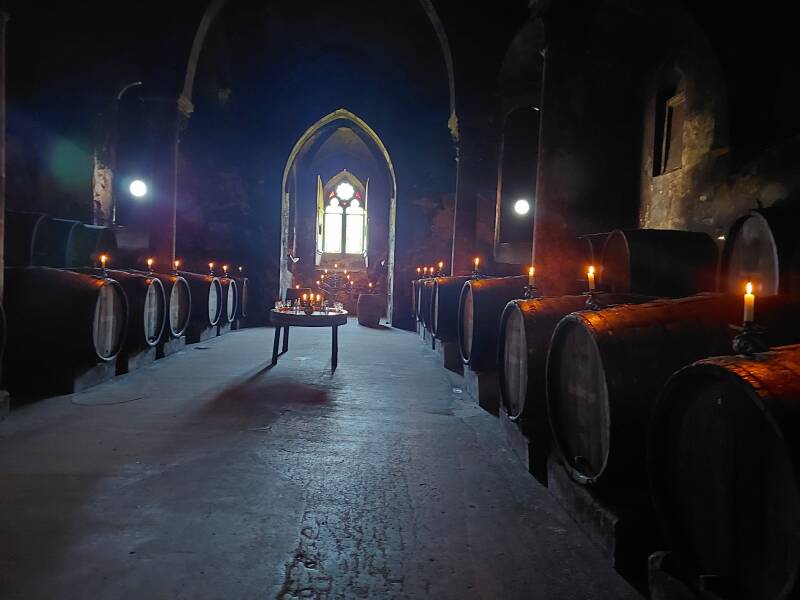
Standing beneath the soaring, austere stone vaults of Eberbach, a breathtaking coincidence unfolded—a cosmic thread connecting this European monastery directly back to my roots. It was here that famed French film director Jean-Jacques Annaud shot his atmospheric cinematic masterpiece, The Name of the Rose (1986). 6 years later, Annaud would move his cameras from the heavy stone of this German monastery to the humid, sun-drenched waters of Sa Dec in the Mekong Delta to film The Lover (1992) — the very landscape of my childhood.
To stand in the Rheingau and realize that the same directorial lens had captured both the sanctuary of my heritage and the playground of my youth was dizzying. Annaud, a master of environmental storytelling, recognized what the Frankfurt Convention Bureau is championing today: that certain spaces possess a profound visual soul capable of shifting human emotion across continents and cultures.
This ancient legacy of design, history, and wine finding perfect harmony is being brilliantly modernized just a short hike away at the newly opened WALD.WEIT Hotel & Retreat. Surrounded by dense forest and panoramic wine-country vistas, this sanctuary — envisioned by the Gemünden/Badrot family — allows architecture to dissolve into nature. Managing this delicate narrative is Sales Manager Sarah Röhl. A musician and former Wine Queen of the Moselle, Sarah acts as a modern custodian of the region's heritage. At WALD.WEIT, she curates immersive experiences where the forest acts as a private gallery and silence is treated as a premium design element. It is the epitome of the new luxury: quiet, authentic, sustainable, and deeply rooted in the land.
A Democratic Creative Future
Previewing World Design Capital 2026
What is happening within the walls of these hotels and wineries is a microcosm of a much grander civic movement. As World Design Capital 2026, Frankfurt RheinMain is ready for Open – Design Week, a massive 10-day festival treating the region as a living laboratory for social impact.
Curated Festival Space
Civic & Design Ecosystem
Next Generation & Worldwide Creative
How youth and global cultures intersect to shape sustainable futures.
Shared Resources & Circular Construction
Regenerative architecture, material innovation, and collaborative systems.
Future Community Space
New structural models designed for civic participation and democracy.
Spanning four cities, the festival will allow visitors to step behind the scenes of creative production:
- Frankfurt: Exploring urban spaces and emerging technologies.
- Offenbach: Focusing on creative production and social transformation.
- Darmstadt: Bridging the gap between scientific research and innovation.
- Wiesbaden: Dissecting communication, branding, and lived environments.
The Traveller's Epilogue
From the open waters of my childhood in Sa Dec to the intentional luxury of the Frankfurt skyline and the quiet cellars of the Rheingau, this journey solidified a beautiful truth for the modern traveller.
True luxury is no longer defined by excess; it is defined by intention. It is found in the way a hotel room frames a forest, the way a director captures the soul of a location, the way a regional festival invites democratic participation, and the way a convention bureau uses its platform to give a child a lifeline. When you visit Frankfurt, you realize that design isn’t merely what you see. It is the invisible thread that connects us all.
------------------------------------------------------------------------------------------------------------------------------------------------------------
Chemnitz – Stad van diversiteit en geschiedenis
Chemnitz, de derde grootste stad van Saksen, ligt in het zuidwesten van de deelstaat en biedt een indrukwekkende mix van historische betekenis, culturele rijkdom en moderne dynamiek. In 2020 werd Chemnitz uitgeroepen tot Culturele Hoofdstad van Europa 2025 en brengt het onder het motto "C the Unseen" de verborgen potentie van de stad en haar omgeving onder de aandacht.
Chemnitz en de omliggende regio, waaronder Zwickau en het Ertsgebergte, hebben een grote rol gespeeld in de industriële ontwikkeling van Duitsland. Textielproductie, machinebouw, de spoorwegindustrie en de automobielsector zijn diepgeworteld in de geschiedenis. De mijnbouwregio Erzgebirge/Krušnohoří werd in 2019 uitgeroepen tot UNESCO-werelderfgoed en vertelt over 850 jaar mijnbouwtraditie. Ook het traditionele
handwerk uit de regio geniet wereldwijd erkenning.
De industrialisatie zorgde niet alleen voor economische bloei, maar luidde ook een culturele bloeiperiode in. De regio biedt gerenommeerde musea, theaters, kunstcollecties en talrijke kastelen uit verschillende tijdperken. Voor natuurliefhebbers zijn er gevarieerde wandel-, fiets- en waterroutes in de omgeving van Chemnitz.
De oude en nieuwe stad verbinden verleden en heden: Het historische stadhuiscomplex van Chemnitz combineert het oude stadhuis uit de 15e eeuw met het nieuwe Jugendstilstadhuis, waar onder andere het beroemde wandpaneel van Max Klinger te zien is. De “Hohe Turm” uit de 12de eeuw biedt bezoekers een adembenemend uitzicht.
Specifieke evenementen in het kader van de Culturele Hoofdstad 2025
Officiële opening: Straatfestival (18.01.2025)
Met een groots straatfestival begint Chemnitz aan het jaar als Culturele Hoofdstad. Onder het motto "C the Unseen" wordt het onzichtbare zichtbaar gemaakt en worden bekende zaken vanuit nieuwe perspectieven gepresenteerd. De festiviteiten vinden niet alleen plaats in Chemnitz, maar ook in de omliggende regio’s. Samen met 38 steden en gemeenten uit Midden-Saksen, het Zwickauer Land en het Ertsgebergte vormt Chemnitz de Culturele Hoofdstadsregio.
Purple Path: Kunst en geschiedenis in het Ertsgebergte (opening 11–13.04.2025)
Een tentoonstelling van Saksische, Duitse en internationale kunstenaars die zich richt op de verbinding tussen mijnbouw, ambacht en industrie. Beelden, Makerhubs en 17 UNESCO-werelderfgoed locaties vertellen verhalen uit 850 jaar mijnbouw onder het thema "Alles komt uit de berg". Een culturele wandelroute die de regio op een nieuwe manier leefbaar maakt.
#3000Garages (09.05.–31.12.2025)
De 30.000 garages uit de DDR-tijd in Chemnitz worden omgetoverd tot creatieve ruimtes en sociale ontmoetingsplaatsen. Festivals, workshops en kunstactiviteiten blazen nieuw leven in deze iconische betonnen bouwwerken en maken ze tot levendige archieven en culturele hotspots.
Europese Culturele Hoofdstad Marathon (18.05.2025)
Een sportief hoogtepunt waarbij het parcours verandert in het langste podium ter wereld. Orkesten, koren en dj’s begeleiden de hardlopers en zorgen voor een onvergetelijke ervaring.
Edvard Munch. ANGST. (10.08.–02.11.2025)
Een tentoonstelling van de Kunstzameling Chemnitz, gewijd aan het thema angst. Naast werken van Edvard Munch, die in 1905 Chemnitz bezocht, worden interactieve stations en AI-toepassingen aangeboden waarmee bezoekers hun eigen kunstwerken kunnen creëren. Workshops en live-performances maken het programma compleet.
Light on our Vision: Lichtkunstfestival (24.–27.09.2025)
Internationale lichtkunstenaars transformeren Chemnitz tot een stralend kunstlandschap. Onder het motto "C the Unseen" worden gebouwen en stadsgebieden op een geheel nieuwe manier belicht, waardoor het potentieel van de stad wordt benadrukt.
Meer informatie op de officiële website van Chemnitz 2025: https://chemnitz2025.de/